


India's Next Hospitality Goldmine Isn't Mumbai or Delhi
The Data-Backed Case for Tier II & III City Investment
Published by Investloft | June 2026
 | Vivek Dhingra Founder, Investloft |
For decades, India's hospitality story was written in eight cities. That chapter is closing — not with a whimper, but with a structural rebalancing that every investor, developer, and hotelier needs to understand.
The numbers are unambiguous. Capital is moving. Brands are signing. And the cities capturing the most momentum aren't the ones you'd find on a legacy investment map.
"India's hotel investment market surged 67% year-on-year to $567 million in 2025 — fueled by aggressive expansion into Tier II and Tier III cities." — Industry Research, 2025
The Great Geographic Rebalancing
India's top eight metros — Mumbai, Delhi, Bengaluru, Hyderabad, Chennai, Pune, Kolkata, Ahmedabad — once commanded an iron grip on the branded hotel market. In 2015–16, these cities controlled approximately 66% of branded hotel inventory. By 2026, that share is projected to fall to just 42%.
This isn't a dip. It's a structural reset. The hospitality economy is decentralising at a pace that few anticipated, and the beneficiaries are cities and towns that barely registered on investor radars five years ago.
The Numbers That Matter
Here is what the data tells us about the scale and speed of this shift:
40% — of hotel transaction volumes in 2025 came from Tier II/III cities
71% — of all branded hotel signings in 2025 were in Tier II/III markets (Industry Research, 2025)
~65% — of upcoming branded room additions are concentrated outside metros
64% — national hotel occupancy in 2025 — a sign of broad-based demand
72–74% — projected premium hotel occupancy in FY2026
₹8,200–8,500 — projected Average Room Rate for FY2026
8–10% — demand growth vs. 5–6% supply growth — demand is winning
The supply-demand imbalance is perhaps the most compelling short-term argument. When demand growth consistently outpaces new supply by 3–4 percentage points, pricing power remains firmly with operators. Industry projections suggest this gap will persist through at least 2028.
What Is Driving Footfall to Smaller Cities?
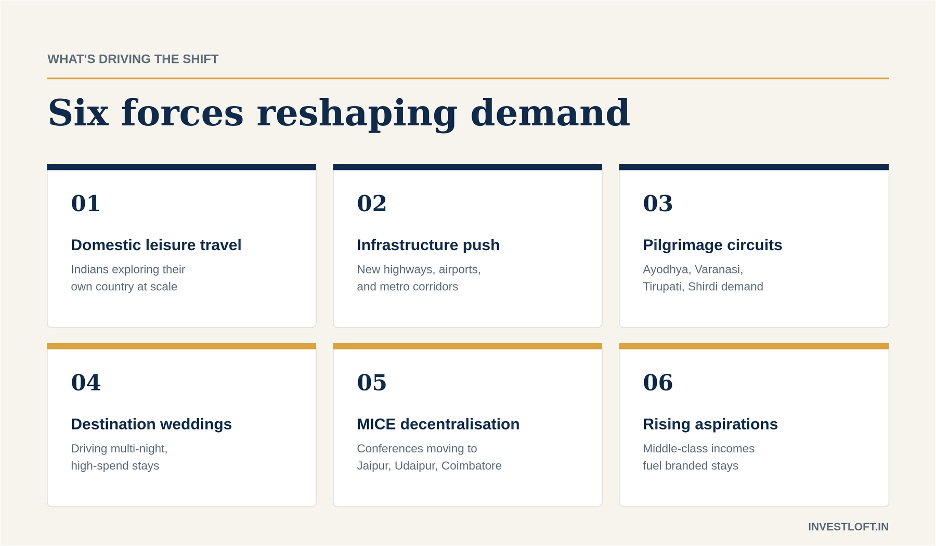
As Ajay K. Bakaya, Chairman of Sarovar Hotels and Director at Louvre Hotels India, has framed it, India's hospitality growth is being shaped by three structural trends: the rise of domestic leisure travel beyond metros, rapid infrastructure development improving access to smaller cities, and a growing preference for branded mid-market hotels offering reliable quality at accessible price points. Layer in pilgrimage tourism, weddings, and MICE, and a fuller picture of the demand shift emerges:
Domestic leisure travel: Over 60% of Indian travellers now prefer exploring their own country, generating consistent year-round demand across regional markets.
Infrastructure acceleration: New highway corridors, airport upgrades (Navi Mumbai, Noida International), and metro expansions are unlocking destinations that were previously logistics nightmares.
Pilgrimage and spiritual tourism: Circuits around Ayodhya, Varanasi, Tirupati, and Shirdi are generating multi-night stay demand that did not exist at scale a decade ago.
Destination weddings: India's large population and cultural affinity for elaborate weddings is pushing demand into leisure and heritage destinations far beyond the metros.
MICE decentralisation: Companies are increasingly hosting conferences and incentive trips in Jaipur, Udaipur, Coimbatore, and similar cities — drawn by capacity, cost, and experience.
Rising middle-class aspirations: Growing disposable incomes are translating into higher travel frequency and a preference for branded, reliable accommodation over unorganised lodging.
The Capital and Brand Response
Institutional capital has taken note. Private equity firms and institutional investors — who bring operational expertise and patient capital horizons — dominated 2025 investment activity, particularly in greenfield development across secondary urban centres.
International hotel chains are restructuring their expansion playbooks. Rather than committing balance-sheet capital to owned properties in unfamiliar markets, most are opting for asset-light models: franchising, management contracts, and local partnerships. This approach enables faster geographic coverage with lower financial exposure.
Domestic hospitality groups are going one step further — moving from standalone hotel development to integrated destination ecosystems that combine accommodation with wellness centres, cultural programming, and F&B experiences. This bundled approach drives longer stays and higher per-guest revenue.
"Nearly two-thirds of upcoming branded hotel room additions are concentrated in Tier II and Tier III cities, driven by rising leisure, spiritual and business travel." — BizzBuzz, March 2026
The Challenges That Cannot Be Ignored
A balanced investment thesis requires acknowledging the friction points:
Talent gap: Approximately 60% of new hotels in non-metro markets report staffing shortages in skilled operational roles. Hospitality education and vocational training infrastructure has not kept pace with expansion.
Last-mile connectivity: While trunk infrastructure has improved dramatically, last-mile connectivity to many emerging destinations remains inconsistent.
Regulatory fragmentation: Approval timelines and operating frameworks vary significantly across states, creating execution risk for multi-market developers.
Financing conditions: The absence of infrastructure status for hospitality — a long-standing industry demand — continues to constrain access to long-tenure, lower-cost capital.
These are real constraints, but they are not structural disqualifiers. They are execution risks that disciplined operators with local knowledge can navigate — and that less prepared entrants will stumble over.
Where Is the Opportunity Concentrating?
Across the data, a few market types are emerging as the clearest opportunity clusters:
Pilgrimage hubs: Ayodhya, Varanasi, Tirupati — high-frequency, year-round demand with very limited branded supply.
Industrial and business corridors: Pune satellite zones, Hyderabad expansion belts, Bengaluru periphery — corporate travel demand with limited upscale inventory.
Heritage and leisure destinations: Jaipur, Udaipur, Coimbatore, Amritsar — growing MICE and wedding demand with strong experiential appeal.
Wellness and nature retreats: Himachal Pradesh, Uttarakhand, Kerala's interior — high-spend travellers seeking immersive, multi-night experiences.

The Investment Thesis in Plain Terms
India's hospitality market is on a remarkable growth trajectory. The market was valued at approximately $61 billion in 2025 and is projected to reach $116 billion by 2034 — a 7.3% CAGR across a decade. But within that aggregate growth, the geographic distribution of returns is shifting decisively.
The brands and investors who understood Tier II/III dynamics 24 months ago are already ahead. They locked in better land prices, signed management contracts before competition intensified, and built relationships with state tourism bodies before the rush.
The question now is not whether this opportunity exists — the data settles that. The question is who is moving with the conviction and execution capability to capture it.
The India hospitality story in 2026 is not being written in Bandra or Aerocity. It is being written in Varanasi, Coimbatore, Indore, and Amritsar.
About Investloft
Investloft is an independent research and insights platform focused on Indian real estate and hospitality investment. We track market trends, brand movements, policy developments, and investment opportunities across India’s hotel and real estate sectors — with a particular focus on Tier II and Tier III cities where the most significant growth is underway.
Our analysis is designed for investors, hotel owners, developers, and industry professionals who want data-driven perspectives on where India’s hospitality economy is heading — and where the opportunities and risks lie.
All research is published at www.investloft.in


Comments